Showing posts with label Hemingway. Show all posts

Monday, January 23, 2012

Papa H

For Christmas Mo bought me several books that connect me to Papa Hemingway and by extension Key West . The first, I Killed Hemingway, is a fine work of fiction by author William McCranor Henderson. Our main man, one Elliot McGuire, is assigned to check out a claim put forward by a man known as 'Pappy' Markham that he not only knew Hemingway but was, in fact, his murderer. Recognizing that this revelation would rock the literary world, McGuire heads to Key West to check out the story for the publisher who is interested in publishing the man's memoir. Ostensibly our man is fact checking, in reality he's doing little more than rubber stamping the project. Roped in to the intrigue, McGuire lends his hand to the telling of the tale, only to find himself readdressing a past he'd thought he buried.

Henderson's story is compelling, keeping readers en rapt with details from Hemingway's life as they are being retold by the irascible Pappy. Character's names are drawn from Hemingway's history- i.e. McGuire's love interest's first name is Lyn- a reference to the biographer Kennith Lynn and the spin on his life (which is all pure fiction according to Pappy) is amusing.  Although the final chapters are rushed and ridiculous, the preceding 250 pages are worth the price of admission and readers may find themselves drawn into the real life drama of Hemingway once the final curtain is drawn.


Next up to bat?  I am in the midst of reading a book called Hemingway's Suitcase- a work of fiction by McDonald Harris. Delving a bit more into the legend's life from a fictional character's perspective, it seems the lost manuscripts that Hadley (Hemingway's first wife) lost have been found. Are they real or are they memorex? I'll let you know...


All this takes me back to the porch I wish I could sit on, tossing about plots and poetic musings. I wouldn't mind reclining here to stir the muse one bit...


Friday, December 31, 2010

Lessons from Libaria for Writers

In 2004, I was the last ditch hiree by the last-resort Principal of a middle school here in Denver, Colorado. I, however naively, was thrilled with the job and jumped in wholeheartedly to the position. Soon thereafter I attended a meeting where a plea was made for reviewers "We need YOU!" The chairperson squawked into the squawky school microphone. An idea had begun forming in my mind, and as the meeting droned on I mulled the pros and cons. As we finished up, I approached the head of the department and asked her for special dispensation so that I (not a teaching librarian) could join THE REVIEW COMMITTEE. She agreed and the rest was, if not history, then at least in the past. SO... I was a paraprofessional librarian who purchased books on a very limited budget (at least most years) for kids who desperately needed good books (most of the kids in my school were very low readers) to read and I reviewed new books that were being published by mainstream publishers... 

I learned a few things. (which is why I joined the Review Committee in the first place. I wanted to review so that I could be a better writer-- it seemed logical that in reviewing other people's books that I would learn a few things about writing. But another bonus: I got free books for my library!)

The first thing I learned is that there are lot of books that are published that are not good. Each month we would gather together and choose from piles and piles of books that publishers would send out and I was astounded at how many of the books we received that were just terrible. As a librarian this was bad news. I had a limited budget. I could not afford to spend money on bad books. I had to learn how to find the books that were worth buying. As an author, I was discouraged to see so many poorly written books sitting on shelves. It seemed to me that this meant that publishers were spending money on books that would not sell... 
My responsibility as a reviewer then led me to a conclusion: Although I hated to tell people that the books they had written were not very good, nevertheless, my colleagues were also working with limited budgets. My reviews were one of the tools they would use to decide how they would purchase materials (but let's be real here I am not god-- my reviews were only one of the tools they might use-- most librarians look at more than one review and even then may bypass reviews if they need a book of a certain genre or topic) . SO It seemed to me, that candid honesty was necessary. If a book was bad, I had to write a bad review. 

I generally read middle school books as those were the audience I was purchasing for but I also read for high school and elementary age children as it became overwhelming to have too many novels to read each month. I found some wonderful books that I read with gusto and recommended to teachers in my building who then passed them on to their students- books I have since seen on the tables of Barnes and Noble. (I like to think it was a slow word of mouth growth that put them there. Barnes and Noble was definitely not promoting The Girl who Could Fly when it was first published!) 

The second thing I learned was that authors did not like getting bad reviews. Not that I blamed them (nor do I still). I have had the bad experience of having manuscripts rejected... it's no fun! And it is less fun to have someone say that you have too many characters and your plot line is disjointed, etc. One writer bullied the reviewer into changing her review and another was extremely cocky and annoying, also pushing for a good review. Lessons were not learned by either writer which is too bad. They were both self-published and I would imagine they will remain that way. As writers we put ourselves out there and reviews are part of the gig. It's part of life. When I was a singer and butchered a song, you could see it written all over the audience's faces (if they were even bothering to look at you). My darling Mo is my harshest critic-- which can be difficult sometimes-- but I have become a better writer as result of his criticism. And even when his criticism is wrong (in other words he isn't seeing what I am getting at at all) it is because my description is poorly done or my dialogue is confusing, etc. so he's still right. Critique is a time for learning. There is a time for cheerleading and supporting... but there is also a time to give real advice, real appraisal. And it's important- maybe more important than the strokes. 


I am reading Hemingway's biography. His editor and closest friend, Max Perkins was the one person who would tell him that what he had written was not his best work. He would encourage him to go back and edit out parts that should be cut or "go back to the drawing board" on others. When he passed away, Hemingway wrote,"Max was a great, great editor and a wise and loyal friend." Hemingway's final works of fiction that were published a few years after Perkins death were notable because only in sections is the writer's touch still evident- his biographer speculates that if his editor and friend had been around he may have been able to distill the best parts of Across the River and drop the worst... 
Even great writers need people to tell them when they have lost their way.          

Friday, October 1, 2010

Writers in Key West


Without a doubt the most famous resident -or former resident- of Key West was Ernest "Papa" Hemingway-- .  

  Calvin Klein owned the Octagon house in Old Town on 712 Eaton Street although he apparently became bored with the island after a year or so and sold this lovely property at a loss rather than live there a moment longer...
  And President Harry Truman came to Key West many times during his tenure in the White house and had a "Little White House" in Key West in which to repose. 
But perhaps the qualifier might be the most famous writer who lived for some length of time on the island. Or perhaps it was that Hemingway brought fame to the island... 
for Hemingway was completely enamored with Key West and only left after he became enamored with another woman (something he did with some regularity- see wife number two, three, and four) making the small island a decidedly tight squeeze for his (second) wife, himself and his mistress. 

But I am putting myself in front of the horse that is pushing the cart. . .
Hemingway's home was initially a reject when Pauline first saw it. She visited the house with her friend Lorrine Thompson but wasn't charmed by the piece of drywall that hit her in the head. When she returned at Lorrine's urging to give the house another chance, she saw the place in a little different light and began renovations that even by today's standards are lovely.  
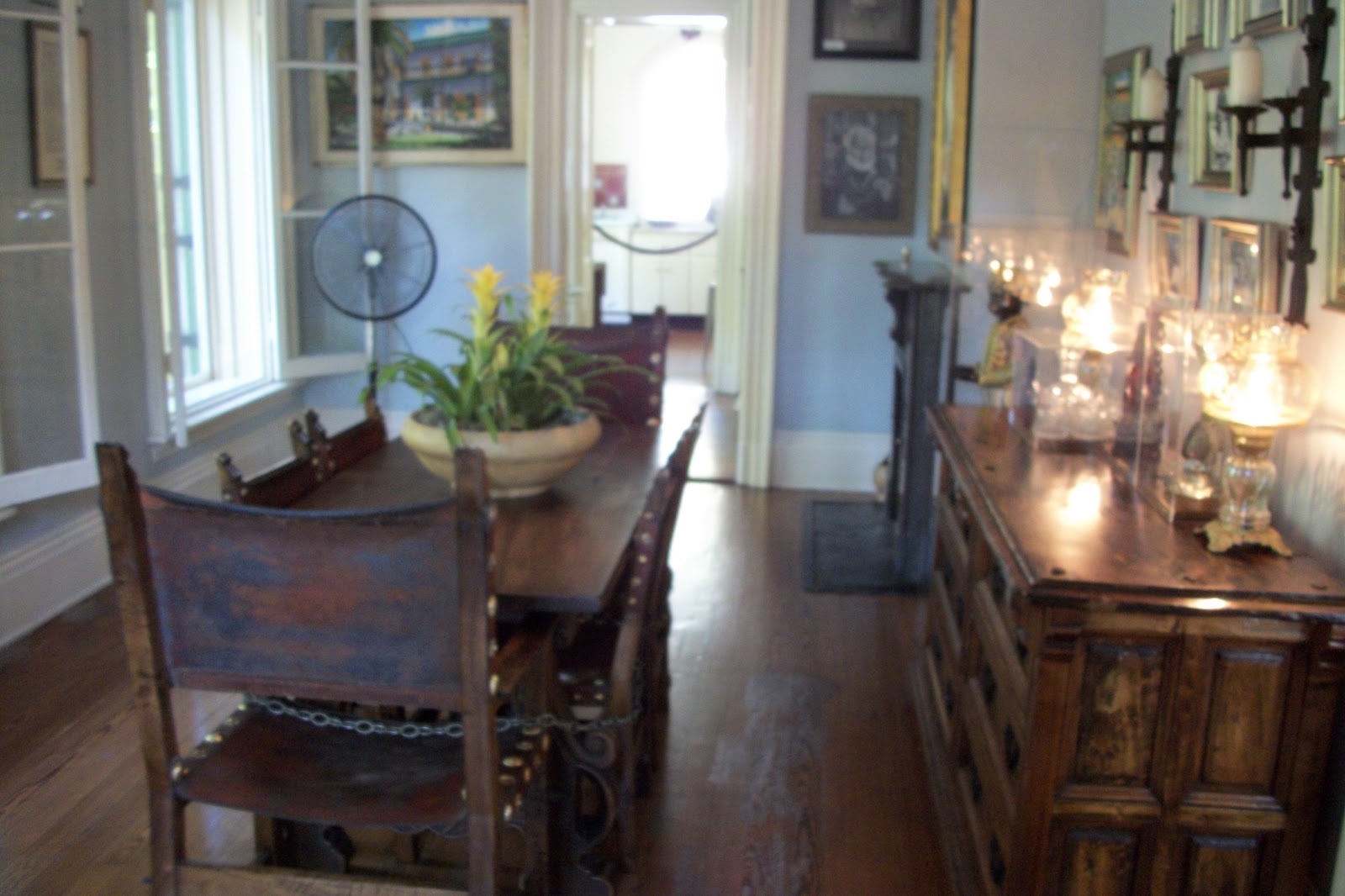
The Hemingways had not a few Dos and one might imagine the tales that were told by the Tallest teller of them all as he stood at one end of the table- his wife perhaps sitting at the other end wishing that his fictions were left to his typewriter.
 
The Hemingway's kitchen is small yet functional even by modern terms. One could easily cook in this kitchen today.  
And this is the studio of a writer's dream! Writer's block? Take a little nap on the reclining chair...
or, just down the stairwell is the pool Pauline built to keep her Writer home and happy. When Hemingway saw the cost of the pool, ($20,000!) he handed Pauline a penny out his pocket, laughed and said, "Well, you may as well have my last cent." You can still see the penny built into the cement around the pool today.    
Unfortunately there are simply too many tourists here today so we'll bid our ados to Hemingway and head down the street, but not too far away...
 This is the Key West Heritage House which is the second oldest house in Key West. It was made into a museum by Jeanne Porter and used to be a tourest stop but was apparently closed to touring in April of this year, more's the pity for Maurice and I as we had planned on touring the house and getting some interior shots.   
So next best thing: We were peaking into the back yard and taking a few shots  when the grounds keeper came up. After Maurice spoke to him for a moment or two he gave us "permission" (that wouldn't stand up in court)  to take a quick peak. 
As I was taking pictures of the lovely tropical garden, I turned and found this--
The cottage where Robert Frost frequented when he came to Key West to escape winter's frosty blast. He was a friend of the aforementioned Jeanne's mother Jesse Porter and he occasioned the island over a period of years. 
But since we're technically trespassing, we should probably be leaving now . . .  Besides it's time to head to New Town where we will find another home which stands in quiet contrast to Hemingway's busy, tourist filled house which is perhaps in keeping with how Hemingway lived. 

On the other side of the island (at least other side at that time) lived another famous American writer who would be a bit more at home in Key West today than he was even then.
 Tennessee Williams came to Key West when he was 30 years old and lived at 1431 Duncan St. It was the only home he ever owned (although he rented others for long periods of time in other locations) and the house was listed as his primary residence until his death in 1983.  
(note: the year on these pictures is wrong although the month and day is correct)
His home is unmarked and untoured. You would have to google his name to find the address but once you show up outside the house you might wonder if you're at the right place, so unobtrusive and modest the property.

A one room bungalow, the property sits only a few feet from the street as do many of the homes in Key West although it reportedly has a pool in the back. Perhaps this particular feature has been sold off or filled in because there didn't seem to be room for a pool but I could be mistaken. Tennessee Williams himself apparently called his little home at the End of the World "Mad House."   
In many ways I found myself more struck by Tennessee Williams home than I was by Hemingway's home. Not just because it is simple and reserved... 
As a music/theater major in college, I read his works, most particularly 'The Glass Menagerie' and later when I became enamored with classic movies I watched 'A Street Car Named Desire' and I could not help but be captured by the drama of it. Tennessee Williams lived a dramatic and traumatic life-- schizophrenic sister and his own struggle with homosexuality (and of course the natural conclusion that he was mentally ill). I would like to have walked through his house, to have spent a quiet afternoon in his garden... 
Alas...  

LinkWithin

Related Posts Plugin for WordPress, Blogger...