So I am going to repost this little section of my comment because I edited it a bit after my initial post (sometimes your writing at night and then realize a later that you need to clarify- so I'll clarify it here). But in the meantime if you want to catch up you can read pt. 1 here and pt. 2 here.
So Kaiser was (and I think is) out there pushing good nutrition and encouraging
their customers to exercise which of course also saves them money- which is a good thing! There
are also other ways that seem logical for insurances to operate that
(at least to the person on the outside) one would say "it seems like it would be
cheaper for the insurance to do... [this]" because in the long run the
patient is treated more efficiently and given better care if they're allowed to go to the doctor they need to get the doctor that treats they're migraines (for example) as opposed to continually just giving pain medication. So, profits
are great if it's done to save sick costs and to raise the health and
wellness of your patients. The problem was that those were not the only
cost savings I witnessed at Kaiser and often the "savings" came at the
expense of patient care.
(end of the rewritten part)
Meanwhile, the pharmaceutical industry is making hand over fist on the medications I need to function. And at this moment, when I have gone through the last 6 days with a migraine each day, I am desperately hoping I can find a doctor who will find out WHAT IS WRONG and not just keep giving me more pills. I was looking over my billing on my insurance account and the cost for two of my Imitrex shots is $285.00! I was stunned by that but the shots work better than the pills so I am glad they cover it even if I can only get 2 for a 2 week period. What I don't understand is, why the same medicine in pill form is so much less ($24 for 4 pills). And it seems like we spend a lot more money on pharmaceutics than we do on how to get rid or prevent. I mean I guess I don't understand why our research isn't leaning that direction (well, I do understand- because pharmaceuticals are Big Business!).
You might say that I am just uneducated about how the whole process works but I did check around and found this out: when my kids were first diagnosed with asthma, an inhaler cost $15. It was difficult to have two children needing a medication that was going to cost that amount as frequently as we would have to buy it but we did what we had to do. A few years later, the price dropped quite dramatically ($6 an inhaler) and I asked the pharmacist why. She said the patent had expired and they were able to offer a generic albuterol inhaler for a lot less. Then last year (maybe longer) the price suddenly jumped to $20 and I what that was all about- was I crazy? Did I need to get the medicine somewhere else? I asked a pharmacist what happened and he/she said that the pharmaceutical company had had the patent renewed and so the price had gone back up.
That's terrible. An albuterol inhaler is not a medication that solves just a pain problem (and I don't say that easily). Having had two children in the hospital, no one knows better than I the implications of not having an inhaler when it's truly needed. On the other hand, I can buy a full box of albuterol solution for my son for $4.00 which is great- if he's going to stay home from school and do a nebulizer (requires a machine) every 4-6 hours. That's not very realistic when usually what he needs is 2 puffs of his inhaler to help him get his breathing under control to get through the day in school.
So I would like to reiterate that my issue here is that it's not that I think it's a horrible thing that a person make money in medicine or healthcare (my daughter is in healthcare- and I definitely don't think she should work for nothing!) or should work for chickens as Michelle Bachman suggested. I just think that there need to be some changes in how we do things so that insurance is more affordable for people who don't have a 40 hr. job in the government.
So, right now I have decent healthcare that does not cost me too terribly much. I attribute that to United Healthcare recognizing they were going to have to offer something that was affordable under the ACA so they put a package together that was truly affordable- and for my income, it is! (Oh and when they offered the more affordable plan, my old plan doubled in cost! And all the co-pays went up!!) By and large I am happy with my actual plan and the insurance company although it's still The Decider about my pain medication (and when I am out of migraine meds and need more but can't get them, I don't feel that generous toward them) and they still decide about my treatment which winds up costing me a great deal of money (and time). In the words of one pharmacist, "The insurance companies are GOD."
And sometimes it means that even with a good healthcare plan- because of the out of pocket expense- I still have to decide if I can afford the treatment or not. Do I go to the doctor for this or do we cut back on food? Which is where I am today because with the economy where it is today, it's not easy to have medical expenses on top of all the other expenses that just seem to keep going up. In other words, it's fine to have inexpensive insurance if you aren't sick but no insurance in America covers everything and that's where things get hung up.
In the meantime did you know that because of the Affordable Care Act that a family of 5 making $50,000 or less can get help subsidized on their insurance? If you didn't know that and if that applies to you, you should check out the website immediately because YOU should be getting whatever help is available to you NOW!!!
Wednesday, October 16, 2013

Tuesday, October 15, 2013
Jack the Ripper...
Today is the anniversary of the "From Hell..." letter that was sent to police by a person who claimed to be Jack the Ripper. According to Wikipedia, this letter was one among hundreds that claimed to be from the killer however, this was one among a few that were thought to be authentic because it was delivered with a human kidney preserved in alcohol. Since Catherine Eddowes' kidney was removed by the killer, it was a logical assumption that the Ripper was sending the kidney along with the letter as a sort of signature. However, the man who received the letter and kidney- a Mr George Lusk- considered the letter and kidney a hoax (he and his colleagues of the Vigilance Committee thought a medical student may have gotten the kidney from a cadaver) and very nearly did not turn it in for evidence until a Dr Frederick Wiles persuaded him otherwise. It also followed a pattern that other letters also thought to be written by the Ripper followed.
 The letter reads as follows...
The mystery of Jack the Ripper has never been solved although there remain many theories about it, it is doubtful that it will be solved because the evidence has either been destroyed or lost or stolen.
It is a fascinating subject though and apropos for Halloween.
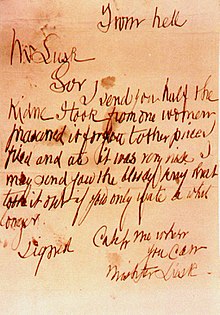
- "From hell
- Mr Lusk
- Sor
- I send you half the Kidne I took from one women preserved it for you the other piece I fried and ate it was very nice. I may send you the bloody knif that took it out if you only wate a while longer
- signed
- Catch me when you can Mishter Lusk"
The mystery of Jack the Ripper has never been solved although there remain many theories about it, it is doubtful that it will be solved because the evidence has either been destroyed or lost or stolen.
 |
| Whitechapel High Street 1905 |
Cue
X-Files theme.
Monday, October 14, 2013
why insurance in the U.S. sucks pt. 2
So great comments everyone! In fact, they are deserving of the Great Commenters award!!
 I responded directly to your comments under the post but the comments were so good that I will bring some of what you said onto the main postings if you don't mind...Anyway, onward through the discussion. For those of you who want to catch up, the first post was here.
Having moved from a regular insurance provider to Kaiser Permanente, the kids and I found the first benefit to the managed care institution was that they had a pretty firm grasp on asthma. My 2 year old son had been hospitalized for five days with a severe asthma attack in April 99 and his sister had experienced some issues at school that the family doctor had not been taking seriously. In both cases I found our GP undereducated about asthma and, especially where my youngest was concerned, unable to help and worse seemingly unwilling to admit it. When we went to Kaiser, they were all about preventing asthma so they immediately tested both children for allergies and sent them to an allergist on a regular basis to get help get their asthma stabilized. All the pediatricians we saw were fairly well educated on what the specialists were doing so we never had to worry that the regular Doc would doubt the prescribed treatment. Kaiser was also partnering with National Jewish which is (or was) leading the nation on asthma treatment so they were doing their very best to keep my kids out of the hospital and in fact out of the doctor's office as much as possible.
At this point I think Ian's comment about healthcare being driven by profit is relevant here (I hope you don't mind if I quote you here, Ian!),
First of all, I was working at Denver Public Schools and had by then gotten a divorce. I was getting my insurance through the school system (by the time the kids dad & I split the monthly cost was $1000) but I stayed with Kaiser because I wanted to keep the doctor I had and (more relevant) I couldn't afford the other plan they offered. The plan was almost the same as the one the kid's dad and I had- same co-pay, same emergency, same pharmaceutical pay-outs, etc. but my cost was $50 a month. The employer cost (as I recall) was $100 a month. The family plan was around $500 a month. As you see, paying as an individual/group is a great deal more expensive than paying in real "group". But that aside, a couple of examples outline the problems with Kaiser.
A friend of mine went on a trip to France and came back with strep which she got on the plane. It was a freakish strain which caused a lot of complications and she had to go to the hospital to the emergency room. She also had Kaiser and it took a bit but they figured out what it was and sent her home with antibiotics. Unfortunately, they did not check her medical chart and see that the type of antibiotics she was on was of the same type that she was allergic to. So she went home and within a short period she had a severe allergic reaction. She was rushed back to the hospital. They switched her antibiotics, kept her for a couple of days and sent her home. The antibiotics were not working and she went back in having developed a staph infection from her first hospitalization and poor treatment. Her body was misshapen and bloated- almost 4 times her regular size! She was there for two weeks and she nearly died. All because they were in a rush to treat her and send her home. It was a frightening time for her and she wound up with scars on her forehead where they had to drain the fluids out. It's graphic and awful, I know. But poor medical treatment is never going to be pretty but at least this story ends with her being okay.
For my part, I was having migraines and they continued to get worse. I had a sympathetic doctor and she was prescribing me Maxalt and Imitrex for my pain. She said there were a couple of preventatives I should try, which I did. One did nothing but the other was a blood pressure lowering medication. My blood pressure is already low so as soon as I went on it, I felt my blood pressure just tank and I felt miserable. I told her and she immediately took me off but said that was it, there was nothing else she could do. They did a CT to make sure there was no brain injury but when I asked about any other doctors I could see, she said there was no one. That was it.
As the years passed, I was having 2-3 migraines a week and there seemed to be no end in sight. At one point I was sitting in the Kaiser pharmacy waiting on my prescription and the pharmacist was clearly working on my prescription, I heard him say, "She can't take this much of this medicine!" It was really loud and if I'd thought that everyone knew he was talking about me, I'd have walked out. A few years ago I was talking to a different and equally passionate pharmacist about my migraine medicine. He told me that Imitrex and Maxalt are triptans and essentially what they do is constrict the blood vessels (if you've ever had a migraine you will know that it feels as though every vessel in your head is going to explode- especially if it's a bad one) but that it can't, obviously, differentiate between the head (where the pain is) and the other vessels in the body. So if you take too much you could throw a clot and have a heart attack or stroke. Nice. That's why the Pharmacist had been so concerned about how medication I was taking but unfortunately it was going to be some years before I would get any preventative to help with my migraines. At my high point (or low- depending on how you look at it) I took 4 in a day (1 beyond what it said I should take- at least then I think it's lower now) but when you are in so much pain that you are throwing up and immobile because of the pain and dizziness in your head, unable to drive, get to work or... do anything for that matter, you will take that extra pill to get the pain to go away.
Another friend who was a teacher in a college also had Kaiser- had an 18 year old son who was still on her medical plan, He became ill his freshman year in college and they discovered he had a rare form of cancer. He came home expecting to be treated but Kaiser told her that the cancer he had had a high mortality rate and they did not support treatment. She had to sue to get Kaiser to get him the treatment he needed. To my knowledge he is still alive and well. That was in 2002 or so.
I don't mean to scare those of you who have Kaiser. If you have it and it's the only insurance you can afford, it's better than nothing but I think you should be aware of the realities. Kaiser is a business that does not like to spend money and like all big corporations wants to cut costs in order to make a profit. My daughter is an EMT and she hates dealing with Kaiser. She has only negative things to say about it and it's because they will not give their patience the care they need when there is an emergency.
I also don't want to sound like I am denigrating the doctors there. I was quite friendly with many of the doctors that I had while I was there but it seemed that they were quite stretched to the limit. They were caring and gentle for the most part- some good doctors! But they were mostly on overload and they did not seem to be very well paid for their trouble. That's why, when I got a new job and went to work for Denver Public Library which is a city agency, I switched insurances FAST.
But there are troubles coming my way with that and we'll get into that later...
So how will things change for those who have an insurance like Kaiser under the ACA in the future? It might get a little cheaper so people who want to opt for another healthcare company can afford to- at least for those states who are actively working to participate fully (like Colorado! YAY US!!!) with the entire population forced to find insurance, there will be more of a pool to even out the costs. I'm not entirely thrilled by that change. I think, like Ian that it would better to not have healthcare be a for profit institution but if the best we do for now is work in the system we have, then this is better than nothing.
So have you had any issues like that where the insurance companies have denied you coverage?

Having moved from a regular insurance provider to Kaiser Permanente, the kids and I found the first benefit to the managed care institution was that they had a pretty firm grasp on asthma. My 2 year old son had been hospitalized for five days with a severe asthma attack in April 99 and his sister had experienced some issues at school that the family doctor had not been taking seriously. In both cases I found our GP undereducated about asthma and, especially where my youngest was concerned, unable to help and worse seemingly unwilling to admit it. When we went to Kaiser, they were all about preventing asthma so they immediately tested both children for allergies and sent them to an allergist on a regular basis to get help get their asthma stabilized. All the pediatricians we saw were fairly well educated on what the specialists were doing so we never had to worry that the regular Doc would doubt the prescribed treatment. Kaiser was also partnering with National Jewish which is (or was) leading the nation on asthma treatment so they were doing their very best to keep my kids out of the hospital and in fact out of the doctor's office as much as possible.
At this point I think Ian's comment about healthcare being driven by profit is relevant here (I hope you don't mind if I quote you here, Ian!),
"The free market and entrepreneurship makes sense in many situations, but I think there are some things that define us as a society that should not be driven by profit. If we want a healthy and well-educated society, we should be measuring the health and education of our population rather than revenue, and behavior should be driven by that."The reason this becomes important is that part of the reason Kaiser is so good at treating Asthma is that it makes sense to treat a preventable disease such as asthma the way they do. If you keep the kids on the proper medication with a preventative that keeps the asthma in check you will keep them out of the hospital which is far cheaper (duh!). And Kaiser has also been out there pushing good nutrition and encouraging their customers to exercise which of course also saves them money. There are also other ways that seem logical for insurances to operate that (to the person on the outside) one would say, "It seems like it would be cheaper for the insurance to do... [this]" because in the long run the patient is treated more efficiently and given better care. So, profits are great if it's done to save sick costs and to raise the health and wellness of your patients. The problem was that those were not the only cost savings I witnessed at Kaiser and often the "savings" came at the expense of patient care.
First of all, I was working at Denver Public Schools and had by then gotten a divorce. I was getting my insurance through the school system (by the time the kids dad & I split the monthly cost was $1000) but I stayed with Kaiser because I wanted to keep the doctor I had and (more relevant) I couldn't afford the other plan they offered. The plan was almost the same as the one the kid's dad and I had- same co-pay, same emergency, same pharmaceutical pay-outs, etc. but my cost was $50 a month. The employer cost (as I recall) was $100 a month. The family plan was around $500 a month. As you see, paying as an individual/group is a great deal more expensive than paying in real "group". But that aside, a couple of examples outline the problems with Kaiser.
A friend of mine went on a trip to France and came back with strep which she got on the plane. It was a freakish strain which caused a lot of complications and she had to go to the hospital to the emergency room. She also had Kaiser and it took a bit but they figured out what it was and sent her home with antibiotics. Unfortunately, they did not check her medical chart and see that the type of antibiotics she was on was of the same type that she was allergic to. So she went home and within a short period she had a severe allergic reaction. She was rushed back to the hospital. They switched her antibiotics, kept her for a couple of days and sent her home. The antibiotics were not working and she went back in having developed a staph infection from her first hospitalization and poor treatment. Her body was misshapen and bloated- almost 4 times her regular size! She was there for two weeks and she nearly died. All because they were in a rush to treat her and send her home. It was a frightening time for her and she wound up with scars on her forehead where they had to drain the fluids out. It's graphic and awful, I know. But poor medical treatment is never going to be pretty but at least this story ends with her being okay.
For my part, I was having migraines and they continued to get worse. I had a sympathetic doctor and she was prescribing me Maxalt and Imitrex for my pain. She said there were a couple of preventatives I should try, which I did. One did nothing but the other was a blood pressure lowering medication. My blood pressure is already low so as soon as I went on it, I felt my blood pressure just tank and I felt miserable. I told her and she immediately took me off but said that was it, there was nothing else she could do. They did a CT to make sure there was no brain injury but when I asked about any other doctors I could see, she said there was no one. That was it.
As the years passed, I was having 2-3 migraines a week and there seemed to be no end in sight. At one point I was sitting in the Kaiser pharmacy waiting on my prescription and the pharmacist was clearly working on my prescription, I heard him say, "She can't take this much of this medicine!" It was really loud and if I'd thought that everyone knew he was talking about me, I'd have walked out. A few years ago I was talking to a different and equally passionate pharmacist about my migraine medicine. He told me that Imitrex and Maxalt are triptans and essentially what they do is constrict the blood vessels (if you've ever had a migraine you will know that it feels as though every vessel in your head is going to explode- especially if it's a bad one) but that it can't, obviously, differentiate between the head (where the pain is) and the other vessels in the body. So if you take too much you could throw a clot and have a heart attack or stroke. Nice. That's why the Pharmacist had been so concerned about how medication I was taking but unfortunately it was going to be some years before I would get any preventative to help with my migraines. At my high point (or low- depending on how you look at it) I took 4 in a day (1 beyond what it said I should take- at least then I think it's lower now) but when you are in so much pain that you are throwing up and immobile because of the pain and dizziness in your head, unable to drive, get to work or... do anything for that matter, you will take that extra pill to get the pain to go away.
Another friend who was a teacher in a college also had Kaiser- had an 18 year old son who was still on her medical plan, He became ill his freshman year in college and they discovered he had a rare form of cancer. He came home expecting to be treated but Kaiser told her that the cancer he had had a high mortality rate and they did not support treatment. She had to sue to get Kaiser to get him the treatment he needed. To my knowledge he is still alive and well. That was in 2002 or so.
I don't mean to scare those of you who have Kaiser. If you have it and it's the only insurance you can afford, it's better than nothing but I think you should be aware of the realities. Kaiser is a business that does not like to spend money and like all big corporations wants to cut costs in order to make a profit. My daughter is an EMT and she hates dealing with Kaiser. She has only negative things to say about it and it's because they will not give their patience the care they need when there is an emergency.
I also don't want to sound like I am denigrating the doctors there. I was quite friendly with many of the doctors that I had while I was there but it seemed that they were quite stretched to the limit. They were caring and gentle for the most part- some good doctors! But they were mostly on overload and they did not seem to be very well paid for their trouble. That's why, when I got a new job and went to work for Denver Public Library which is a city agency, I switched insurances FAST.
But there are troubles coming my way with that and we'll get into that later...
So how will things change for those who have an insurance like Kaiser under the ACA in the future? It might get a little cheaper so people who want to opt for another healthcare company can afford to- at least for those states who are actively working to participate fully (like Colorado! YAY US!!!) with the entire population forced to find insurance, there will be more of a pool to even out the costs. I'm not entirely thrilled by that change. I think, like Ian that it would better to not have healthcare be a for profit institution but if the best we do for now is work in the system we have, then this is better than nothing.
So have you had any issues like that where the insurance companies have denied you coverage?
Sunday, October 13, 2013
NaBloWriMo day 13

Subscribe to:
Posts (Atom)
LinkWithin
